Djinn City by Saad Z. Hossain
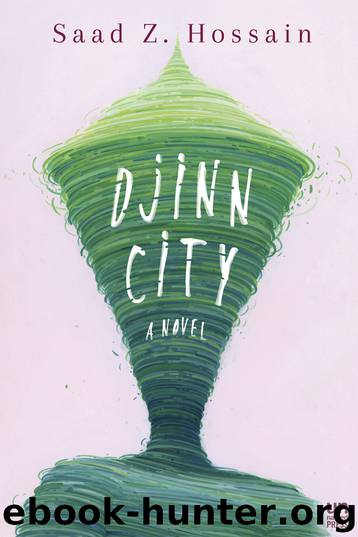
Author:Saad Z. Hossain
Language: eng
Format: epub
ISBN: 9781944700447
Publisher: The Unnamed Press
Published: 2017-10-20T04:00:00+00:00
CHAPTER 30
Kaikobad
It had been months since they had seen Memmion. The golden giant invoked atavistic fear in the First City these days. Every so often some out-watcher would claim to see him over the horizon, and the citizens would quake. There were effigies of him burning on every street corner, at the foot of every tower. The port quadrant of the city was permanently flooded now, a sloshing, stagnant marshland, the streets largely abandoned. Ships still braved the ocean, bringing food and supplies to the beleaguered empire, old trading partners maintaining alliances.
Rumors abounded, hope and despair jumbled together in manic-depressive splendor. The rebellion had ended, the enemy were scattered. Givaras the Broken was raising an army against them, the likes of which had never been seen. Memmion had made an airship and was going to attack from the skies. Kaikobad wandered the cafés lining the raised ocean promenade, now level with the sea. The patrons still came to lounge here in defiance, smoking their pipes, even though their feet got wet with every swell, and the bamboo furniture was all rotted with seawater. He knew all the regulars, had heard their stories.
Actual news from Lhasa was dire. The one true rumor was that the Ghuls had abandoned them. The djinns were not only one race, but three that Kaikobad knew of. Possibly there were more, or once had been, but as with so many things djinn, the knowledge was lost or deliberately obfuscated. The Ifrit were the most numerous, and the Marid more powerful, although it was unclear whether they were simply a type of Ifrit or a separate race altogether. The Ghuls, more numerous than the Marid, were distinct in several ways. They were physically stronger and faster, and typically held to be less intelligent, almost beastlike. It was rumored that they could not control their fields, although this was probably bigotry. They were taciturn and uncommunicative even to other djinn, and shunned contact with humans and Nephilim. The central culture of the djinn, dominated by Ifrit, treated the Ghuls as a subservient race.
Certainly, as a political unit, they were weak. They served in a largely menial capacity in the djinn world, as crew in ships, as builders, porters, and artisans, a cross between guildsmen and indentured servants, often working for food and a pittance. Gangaridai was built on Ghul labor, and they had received scant reward for all of that. Individual Ghuls did not seem to have dignatas, or at least so little that it was hardly worth acknowledging. Rather, the dignatas accrued to each Ghul tribe, of which there were many, the largest being centered in Lhasa. Their inner workings were secretive, and it was unclear to outsiders the exact hierarchy.
Over the past months, Ghuls had been leaving the city, more and more disappearing every night. This had been dismissed as the normal attrition of war: trade drying up, workers leaving for safer pastures. But now news came that Horus, named Givaras the Broken by the Ghul,
Download
This site does not store any files on its server. We only index and link to content provided by other sites. Please contact the content providers to delete copyright contents if any and email us, we'll remove relevant links or contents immediately.
| Fantasy | Gaming |
| Science Fiction | Writing |
We Ride Upon Sticks by Quan Barry(34493)
The Secret History by Donna Tartt(18993)
Norse Mythology by Gaiman Neil(13312)
Crooked Kingdom: Book 2 (Six of Crows) by Bardugo Leigh(12283)
The Betrayed by Igor Ljubuncic(11841)
The Betrayed by Matthew Dickerson(11611)
Caraval Series, Book 1 by Stephanie Garber(10237)
Year One by Nora Roberts(9758)
Twilight Siege: A Dark Fantasy Novel (The Fae Games Book 2) by Jill Ramsower(9596)
Oathbringer by Brandon Sanderson(9591)
The Priory of the Orange Tree by Samantha Shannon(9042)
The City of Brass by S. A. Chakraborty(8846)
Red Rising by Pierce Brown(8727)
Confessions of an Ugly Stepsister by Gregory Maguire(7862)
Little Fires Everywhere by Celeste Ng(7167)
This Is How You Lose Her by Junot Diaz(6854)
Shalador's Lady by Anne Bishop(6836)
Storm and Silence by Robert Thier(6816)
Iron Flame by Rebecca Yarros(6809)
